

We, who are students, try to focus on our studies throughout the year. But we can’t do it. Actually how does inspire work?

Again, just before the exam, all the motivation seems to accumulate in our brains. Even giving up eating, we start preparing for the exam.
Then we sadly say, ah! If we had utilized it all the time, we wouldn’t have to work so hard. If you are facing this type of problem, then today I will share a famous book, “Drive”.
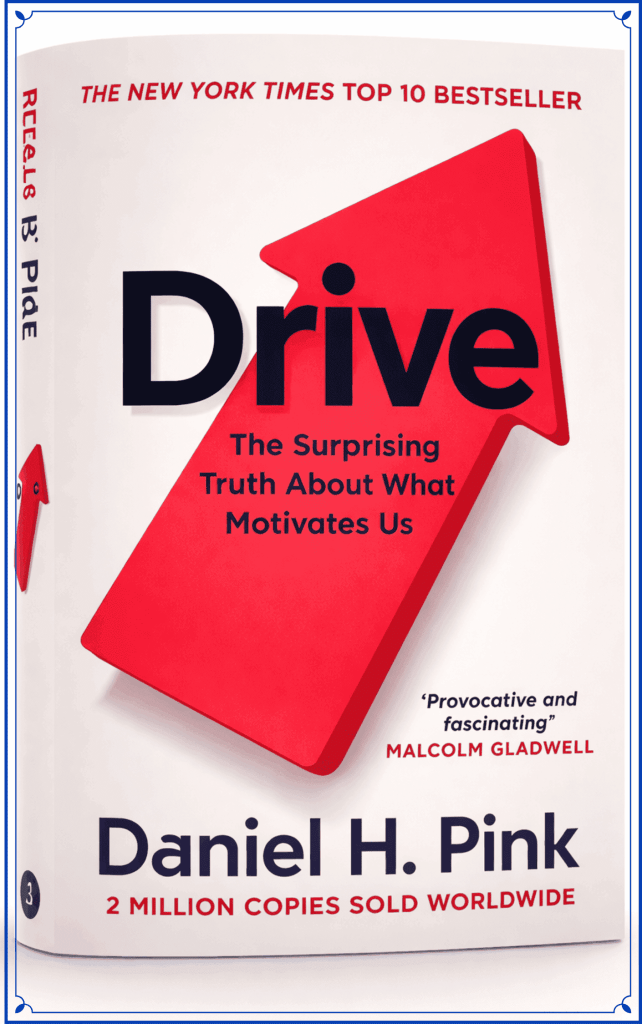
The book is written by Daniel Pink. What Things Actually Motivate Us? Daniel has researched for almost 40 years to get the right answer. Then he wrote this book.
This is a best-selling book all over the world. So, let’s see what ways there are to overcome the lack of motivation, in light of this book.
The author has given a theory called the carrot-stick approach. According to him, this theory was correct until the 20th century.
But this theory has become outdated in the 21st century. He has mainly divided motivation into 3 categories. The first step is motivation 1.0 or basic needs.
The drivers of this motivation are mainly biological needs. Such as collecting food and adventure or the struggle to survive.
But it was adequate until the 19th century. The second step is motivation 2.0 or external motivation. Its drivers are extrinsic motivators.
Such as: money, wealth, house-car. That is, in this state we only want to enjoy these things but don’t want to be punished.
But it was appropriate for the 20th century, when people felt happy to buy a television or a radio. The third step is motivation 3.0 or internal motivation.
The drivers of this motivation are also intrinsic motivators. These include emotions or interests, which are appropriate for the 21st century.
In this state, we always harbor a desire to do something new in our minds. We desire to learn something new. We desire to make this world better and more enjoyable.
But there are three stages or elements of this internal motivation. The first stage or element is autonomy. Autonomy is the ability to take action according to one’s own will. It has four categories.
Number 1 is task. That is which task to prefer. Number 2 is time. That is, when to prefer the task. Number 3 is team. That is, with whom to prefer the task. Number 4 is technique.
That is, how to do the task. These four basic elements are essential to activating internal motivation. For example, think of Google.
These facilities are provided for everyone who works in this company. The Second Element Is Mastery. Mastery is freedom in relation to a subject.

Choosing the subject that one likes. The thing that seems meaningful to you and the desire to make it better. Challenging one’s own limitations and improving little by little.
Two elements are needed to encourage mastery. The first is to create a condition for improvement. The 2nd is to identify and celebrate after achieving improvement.
Purpose is something that is bigger than oneself. For this, 3 things need to be kept in mind. First, purpose should be a top priority of all time.
And results should only be used as a catalyst. Second, focus should always be on the word “why” and less importance should be given to the word “how”.
And third, purpose should be created by you instead of following or watching others. Only by managing these things can internal motivation or motivation 3.0 be fulfilled.
In 1945, a psychologist named Karl Duncker discovered a test called the candle problem. With its help, a person’s creative ability can be tested.
This test is such that a matchbox, some pins and a candle are given. And during the test, it was said that the candle has to be set on the wall in such a way that the wax from the candle does not fall on the table after melting.
To do this test, a scientist made two groups. Through the first group, he wanted to observe how much time it takes on average for a person to complete this test.
But he told the second group that the first person to complete the test would be awarded $50. That is, he introduced a reward system.
As a result, it is seen that those who were asked to complete the test without a reward were able to complete it in a relatively shorter time.
This test shows that the reward system creates a negative effect on creativity. That is, the reward system destroys creativity.
But many companies have a rule of giving bonuses based on the performance of employees. So is this wrong? If mechanical work is done in those companies, then it is logical.
The author has called this the “If you do it then you will get it” theory. But if creativity or any invention is involved in a company, then this method is not at all correct.
Here, the “Now… Then the” reward system “is more appropriate. Giving rewards for good results, praising new discoveries, innovations or ideas.
Because praising this kind of creative work plays a very positive role. Another thing is that if the reward is much higher than the performance, it can bring the opposite result.

Creativity can be destroyed. For example: if a car mechanic is told that he will be given a double bonus if he repairs 50 cars per month.
As a result, he will try to find faults in even good cars. As a result, he may have a negative impact on the customers. Therefore, the reward system must be balanced.
So, from the summary of this writing, it can be said that to activate the inner motivation, one needs the freedom to choose.
Secondly, to become skilled or master at that work. Thirdly, to set a purpose that is above self-interest and is seen as bigger than oneself.